
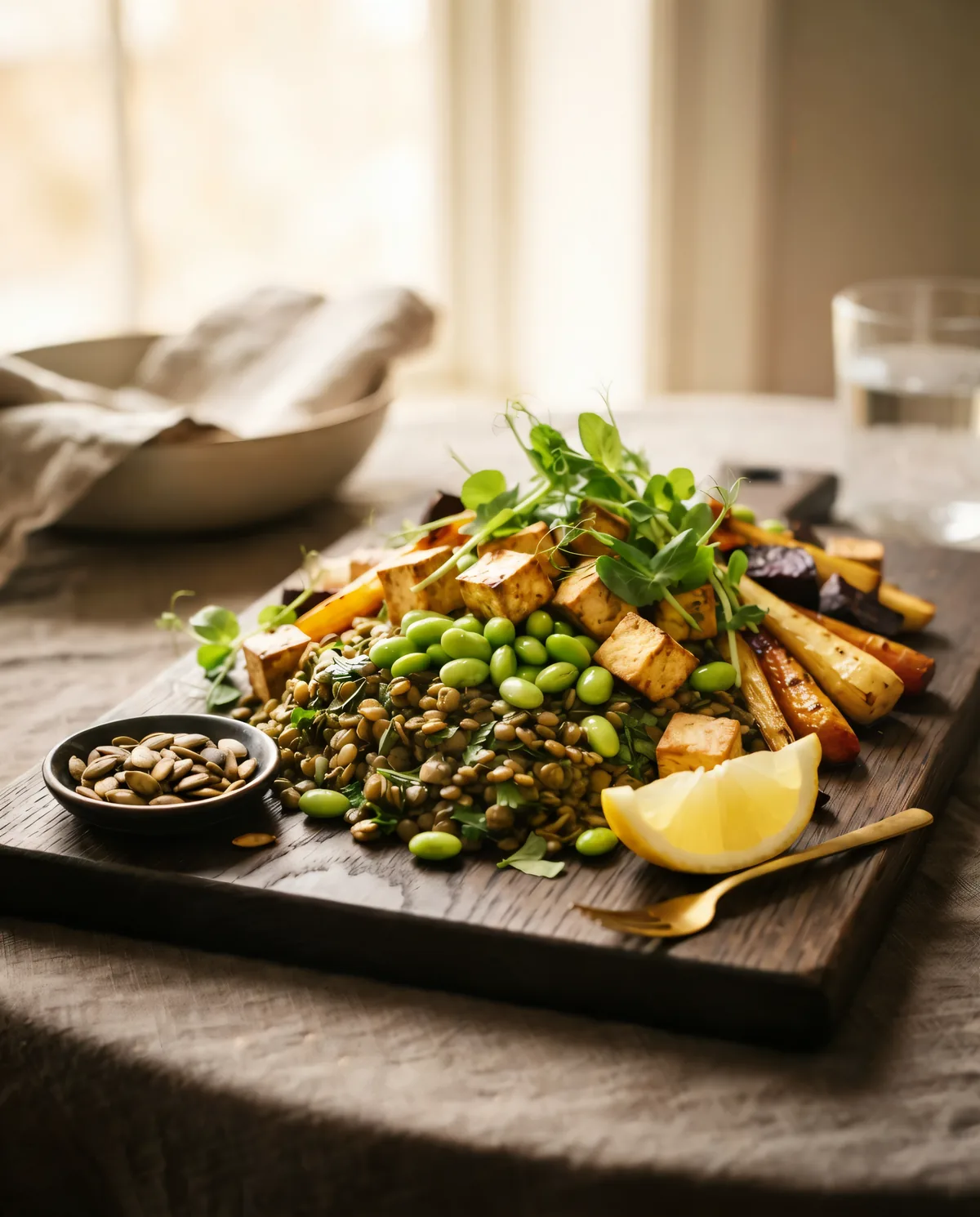
Hair is a sensitive gauge of what the body is short of: a follicle is one of the fastest-dividing tissues there is and the first put on hold when iron, protein, zinc or energy run low. That is why a change of diet, including a change to a vegan one, can show up in the brush three or four months later. It is also why the fix is usually a blood test and a plate, not a biotin gummy.
This page covers the nutrients the hair literature keeps finding, the amounts the European Food Safety Authority sets, where they are on a plant-based plate, and the honest limit: most hair loss has nothing to do with food.
First, the causes that are not the diet
Hair sheds in cycles, and a major life event, an illness, a fever, childbirth, surgery, a new medication or a crash diet can push a large share of follicles into the resting phase at once, with the shedding arriving two to four months later and resolving on its own in six. Pattern hair loss is genetic and hormonal and affects half of adults by fifty. Thyroid changes, autoimmune conditions and scalp conditions have their own signatures. A good clinician sorts these in one visit, and persistent or patchy loss, or loss with other symptoms, belongs with one before any plate is rebuilt.
What the diet can do is remove a nutritional cause when there is one, and the review evidence is specific about which ones.
The hair ledger in one table
| Nutrient | What the review found | Blood test | EFSA reference, adult women | Plant sources, per portion |
|---|---|---|---|---|
| Iron | low ferritin linked with shedding; correcting it helped | serum ferritin, full blood count | 16 mg a day, ages 18 to 50 | lentils 6.6 mg per 200 g, firm tofu 4 mg per 150 g, pumpkin seeds 2.6 mg per 30 g |
| Zinc | low zinc linked with shedding; supplements helped only where low | serum zinc | 7.5 to 12.7 mg a day, upper limit 25 mg | pumpkin seeds 2.2 mg per 30 g, hemp seeds 3 mg per 30 g, lentils 2.5 mg per 200 g |
| Vitamin B12 | on the list to check; not in plants | serum B12 | 4 mcg a day | fortified yeast and milks by the label, a supplement |
| Vitamin D | low vitamin D linked with shedding | 25-hydroxy vitamin D | 15 mcg a day | summer sun, fortified milks, a supplement in winter |
| Protein and energy | follicles pause when either drops | none; the food diary | 0.83 g per kg a day | tofu 17 g per 150 g, lentils 18 g per 200 g, tempeh 19 g per 100 g |
| Biotin | helped only when deficient | rarely needed | 40 mcg a day | a mixed plant-based diet |
Iron, and the ferritin number
The 2019 review in Dermatology and Therapy of vitamins and minerals in hair loss found low iron stores (ferritin), low vitamin D and low zinc linked with shedding across the studies reviewed, and correcting a measured deficiency helped. Iron is the one most relevant to a vegan plate: a 2018 meta-analysis of 27 studies found vegetarians had lower serum ferritin than non-vegetarians, with the clearest gap in women. The contrary finding matters: haemoglobin differed little or not significantly in several of the pooled studies, so lower stores did not always mean anaemia, and the hair review’s evidence was mostly observational.
The EFSA population reference intake for women aged 18 to 50 is 16 mg of iron a day, set high because plant iron (non-heme) is absorbed at 5 to 12 percent against 15 to 35 percent for heme iron. The plant sources: lentils 6.6 mg per 200 g cooked, firm tofu 4 mg per 150 g, pumpkin seeds 2.6 mg per 30 g, cooked spinach 3.6 mg per 100 g, white beans 7 mg per 200 g, fortified oats by the label. Absorption is the lever: vitamin C at the same meal, as a squeeze of lemon, tomatoes or a pepper, roughly doubles non-heme iron uptake in the absorption studies Hurrell and Egli summarised, while tea and coffee within an hour of the meal cut it by half or more. The test is serum ferritin, and most clinicians look for a value above 30 micrograms per litre before ruling iron out as a cause of shedding; below that, food plus a supplement prescribed on the result is the path, not a supplement guessed in advance.
Zinc
Zinc contributes to the maintenance of normal hair, and low zinc appeared in the hair loss review alongside iron. The EFSA reference for women runs from 7.5 to 12.7 mg a day depending on phytate intake, with a vegan plate at the top of that range, and an upper limit of 25 mg a day from all sources. Pumpkin seeds carry 2.2 mg per 30 g, hemp seeds 3 mg per 30 g, lentils 2.5 mg per 200 g, oats 1.6 mg per 40 g, tempeh 1.1 mg per 100 g. Sourdough bread, soaked legumes and sprouted grains free more of it. The review’s caution applies here too: zinc supplements helped where zinc was low and did nothing where it was not, and more is not better.
Vitamin B12
B12 is not made by plants, and a vegan plate without a fortified source or a supplement runs it down over one to several years as the liver store is used up. Low B12 shows in the blood, the nerves and the energy long before the hair, but the hair review lists it among the nutrients to check, and a vegan who sheds and has not supplemented should have it measured. The EFSA adequate intake is 4 micrograms a day; fortified nutritional yeast, fortified plant milks and cereals carry what their label says, and a supplement is the reliable route for anyone fully plant-based. This is the one nutrient on the site where the advice is not “eat the food”, because there is no food.
Vitamin D
Low vitamin D was one of the three nutrients the hair review linked with shedding. The EFSA adequate intake is 15 micrograms a day, and north of about 50 degrees latitude there is no skin synthesis from October to March, so in Scandinavia, Britain and the northern United States it is a winter question for everyone, vegan or not. Fortified plant milks and spreads carry a little; the rest is sunlight in summer and a supplement in winter, chosen as vegan D2 or lichen-derived D3 and measured if there is any doubt.
Protein and enough food
Hair is almost entirely keratin, a protein, and a follicle stops building it when protein or total energy drops. The two diet patterns the hair clinics see most are the crash diet and the accidental under-eating of a new vegan plate built on vegetables and fruit without an anchor of legumes, soy or grains. The EFSA reference intake is 0.83 g of protein per kg a day; the plant anchors are tofu (17 g per 150 g), lentils (18 g per 200 g), tempeh (19 g per 100 g), edamame (17 g per cup) and seitan (25 g per 100 g). A plate that reaches 20 g at each meal covers the hair with room to spare. Eating enough in total matters as much: shedding after rapid weight loss is common and settles once intake is restored.
Biotin, and what not to take
Biotin is the supplement sold for hair, and the hair review’s finding was narrow: biotin helped only when a deficiency was present, which is rare outside specific conditions. The EFSA adequate intake is 40 micrograms a day and a mixed plant-based diet supplies it. High-dose biotin also interferes with common laboratory tests, including thyroid and cardiac markers, which is a reason to tell a clinician about it. The same review found the opposite problem with two others: too much vitamin A and too much selenium were themselves associated with hair loss, and the EFSA upper limit for selenium is 255 micrograms a day, which a daily Brazil nut habit can approach. The pattern across the whole review is the same: correcting a measured shortfall helps, and adding what is not short does nothing or harms.
What to do, in order
- Note when the shedding started and what changed three to four months before it: diet, illness, a shock, medication, a birth.
- Ask for the blood tests the 2019 review points to: full blood count, serum ferritin, vitamin B12, vitamin D, zinc and thyroid function. One visit, one draw.
- Fix what the results show, with a supplement where prescribed and the plate in every case: an iron anchor at two meals with vitamin C beside it, pumpkin and hemp seeds daily, a B12 source every week, enough protein and enough food.
- Give it six months. Hair that stopped growing takes that long to show the difference, and judging at six weeks is how people conclude nothing works.
- If the loss is patchy, scarring, sudden, or continues past six months with normal bloods, see a dermatologist; the cause is not on the plate.
What the research says
- Almohanna and colleagues, Dermatology and Therapy, 2019, narrative review of adults with hair loss in the studies reviewed, correction of measured deficiencies over months, diet and supplements: low iron (ferritin), vitamin D and zinc were linked with shedding and correcting a measured deficiency helped; biotin helped only when a deficiency was present. The contrary finding: most evidence was observational, and too much vitamin A or selenium was itself associated with hair loss. doi.org/10.1007/s13555-018-0278-6
- Haider and colleagues, Critical Reviews in Food Science and Nutrition, 2018, meta-analysis of 27 studies of adult vegetarians and vegans against non-vegetarians on habitual diet, cross-sectional measurements: vegetarians had lower serum ferritin, with the clearest gap in women. The contrary finding: haemoglobin differed little or not significantly in several of the pooled studies, so lower stores did not always mean anaemia. doi.org/10.1080/10408398.2016.1259210
- Hurrell and Egli, The American Journal of Clinical Nutrition, 2010, review of iron absorption studies in adults used to set dietary reference values: non-heme iron absorption ranged from about 5 to 12 percent on plant-based diets, roughly doubled by vitamin C at the same meal and halved by tea or coffee. The contrary finding: absorption figures come from single-meal isotope studies, and whole-diet adaptation raises uptake when stores are low. doi.org/10.3945/ajcn.2010.28674F
Questions people ask
Will my hair grow back if I fix my iron? If low iron was the cause, the shedding usually settles within a few months of the stores recovering and the regrowth follows over six to twelve. If it was not the cause, iron will not change it, which is why the test comes before the supplement.
Is soy bad for hair? No study shows that. Soy foods are among the best plant sources of protein, iron and zinc, which is the opposite of a problem for hair.
Do I need a hair supplement? Not as a category. The review evidence supports replacing what a blood test shows is low, and nothing supports a multi-ingredient hair formula in someone whose results are normal.
How much hair loss is normal? Around 50 to 100 hairs a day, more on wash days, and a seasonal rise in autumn. A handful in the shower every day for weeks, a widening parting or visible thinning is the point to get the tests done.