
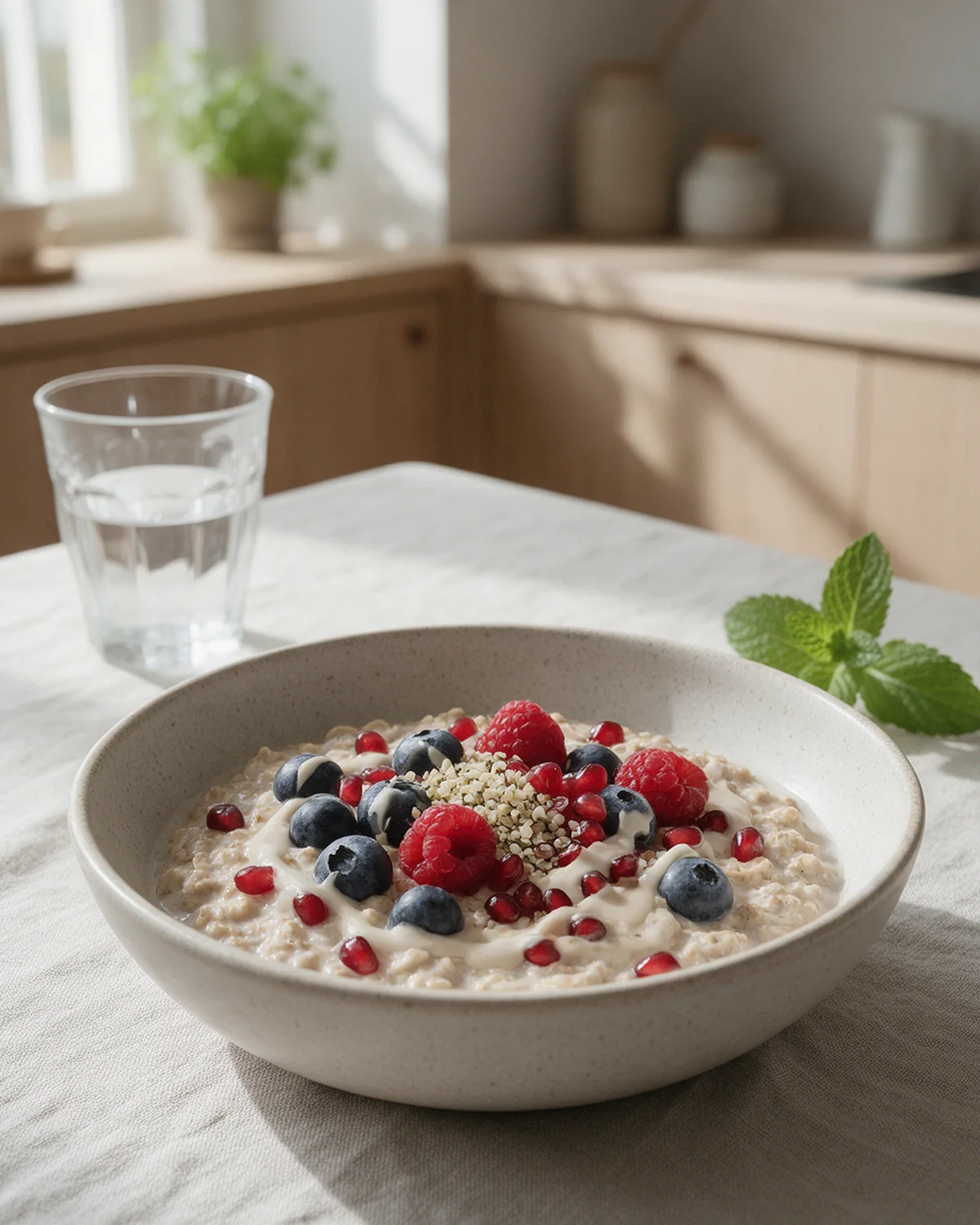
Skin is the body’s largest organ and it is built, repaired and replaced from what is eaten: collagen from protein and vitamin C, the surface from fats, the barrier from zinc and vitamin A. That much is physiology and nobody disputes it.
What the internet adds, and the evidence does not, is the claim that eating more of any of these makes already well-fed skin visibly better. This page keeps the two apart: the nutrients with a recognised role in normal skin function, the plant foods that carry them, the amounts the European Food Safety Authority sets for adults, and the studies that looked at diet and skin appearance, with their limits stated.
What the evidence actually shows
The largest study of diet and skin appearance is a cross-sectional analysis of 4,025 American women aged 40 to 74 from the NHANES I survey. Higher vitamin C intake was associated with a lower likelihood of a wrinkled appearance, and higher linoleic acid intake with less dryness and thinning; higher fat and carbohydrate intakes went with more wrinkles. The contrary finding is built into the design: a single assessment of self-reported diet cannot say which came first, and the odds ratios were modest, around 0.89 per unit of vitamin C intake. It is a reason to eat the foods, not a promise about the face.
Below that one study sit the nutrient functions that food law allows on a label, because they are established: vitamin C contributes to normal collagen formation for the normal function of skin; vitamin A, zinc, biotin, niacin and riboflavin contribute to the maintenance of normal skin. “Normal” is the word doing the work. These are statements about what a deficiency takes away, not about what a surplus adds.
The ledger in one table
| Nutrient | Recognised role | EFSA reference, adult women | Plant sources, per portion |
|---|---|---|---|
| Vitamin C | normal collagen formation for normal skin function | 95 mg a day | red pepper 130 mg per 100 g, blackcurrants 180 mg per 100 g, strawberries 60 mg per 100 g, orange 53 mg per 100 g |
| Vitamin A | maintenance of normal skin | 650 mcg RE a day | carrots about 700 mcg RE per 100 g, sweet potato, kale, spinach, apricots |
| Zinc | maintenance of normal skin, hair and nails | 7.5 to 12.7 mg a day by phytate intake, upper limit 25 mg | pumpkin seeds 2.2 mg per 30 g, lentils 2.5 mg per 200 g, firm tofu 2.4 mg per 150 g |
| Linoleic acid | skin barrier lipid; less dryness at higher intakes in the NHANES I study | 4 percent of energy, about 9 g a day | walnuts 11 g per 30 g, hemp seeds 8 g per 30 g, sunflower seeds 7 g per 30 g |
| Omega-3 | EPA plus DHA status; low conversion from ALA | 250 mg EPA plus DHA a day | ground flax 6 g ALA per 30 g, walnuts 2.6 g ALA per 30 g, algal oil for DHA |
| Protein | collagen, keratin and elastin are proteins | 0.83 g per kg a day | tofu 17 g per 150 g, lentils 18 g per 200 g, tempeh 19 g per 100 g |
Vitamin C
Collagen cannot be built without it: two enzymes in the chain need vitamin C to fold the protein properly, which is why scurvy shows up first in the skin, gums and wound healing. The EFSA population reference intake for adult women is 95 mg a day and the US RDA is 75 mg; a red pepper carries about 130 mg per 100 g, blackcurrants 180 mg, strawberries 60 mg, an orange 53 mg, broccoli 90 mg raw and about 65 mg cooked. One red pepper or a bowl of blackcurrants covers a day on its own; a plant-based plate with any fruit and vegetables rarely falls short of this one. Heat and water take some of it, so raw or lightly steamed keeps more.
Vitamin A and the carotenoids
Vitamin A contributes to the maintenance of normal skin and the normal function of the immune system; it governs how skin cells mature and turn over. On a plant-based plate it comes as beta-carotene, which the body converts to vitamin A as needed, so there is no risk of the excess that comes with retinol supplements. The EFSA reference for women is 650 micrograms of retinol equivalents a day; 100 g of carrots carries about 8 mg of beta-carotene, roughly 700 micrograms of retinol equivalents, and sweet potato, kale, spinach and apricots are in the same league. Carotenoids are fat-soluble, so a little oil, avocado or seeds on the same plate roughly doubles what is absorbed.
Carotenoids also deposit in the skin itself and give it a faint warm tone that observers rate as healthy in studies of skin color; this is a measurable, modest effect of fruit and vegetable intake over about six weeks, not a tan and not a treatment.
Zinc
Zinc contributes to the maintenance of normal skin, hair and nails, and sits in hundreds of enzymes including the ones that repair the skin barrier. It is the plant-based nutrient most worth watching because phytate in whole grains and legumes binds it: the EFSA reference for women runs from 7.5 mg a day on a low-phytate diet to 12.7 mg on a high-phytate one, which is where a vegan plate sits. Pumpkin seeds carry 2.2 mg per 30 g, lentils 2.5 mg per 200 g cooked, firm tofu 2.4 mg per 150 g, oats 1.6 mg per 40 g dry, cashews 1.7 mg per 30 g. Soaking, sprouting and sourdough fermentation reduce phytate and raise what is absorbed. The upper limit EFSA sets for adults is 25 mg a day, which a supplement reaches easily and a plate does not.
The essential fats
Linoleic acid is the omega-6 fat the skin barrier is made with; a deficiency produces scaly, dry skin within weeks in the experimental studies, and in the NHANES analysis higher intakes went with less dryness and thinning. The EFSA adequate intake is 4 percent of energy, about 9 g a day on a 2,000 kcal diet; 30 g of walnuts carries 11 g, sunflower seeds 7 g, hemp seeds 8 g. Plant eaters rarely fall short of linoleic acid.
Omega-3 is the harder one. Flax, chia and walnuts supply ALA, and the body converts little of it to EPA and very little to DHA: the 2014 review of vegetarian omega-3 sources found that vegans have lower DHA status and that algal oil at 200 mg to 2 g a day raised DHA in blood comparably to fish oil in the trials reviewed. The contrary finding is that no trial in that review tied the lower DHA status of vegans to a measured health outcome, in the skin or anywhere else. The EFSA adequate intake for EPA plus DHA is 250 mg a day; the plant-based ways there are algal oil or accepting the ALA route with 30 g of ground flax (6 g of ALA) or walnuts (2.6 g) most days.
Protein
Collagen, keratin and elastin are proteins; skin is about 70 percent collagen by dry weight. The EFSA reference intake is 0.83 g per kg a day for adults, about 55 g for a 65 kg woman, and the hair and skin literature has no evidence that more than an adequate intake does anything further for either. Tofu carries 17 g per 150 g, lentils 18 g per 200 g cooked, tempeh 19 g per 100 g, edamame 17 g per cup. A plate that reaches 20 to 30 g of protein at each meal, which is the muscle literature’s threshold rather than the skin’s, covers the skin with room to spare.
What food cannot do
Three things need saying plainly. First, acne, eczema, rosacea, psoriasis and pigmentation disorders are medical conditions with their own causes, and the evidence that diet alone resolves any of them is thin to absent; a dermatologist, not a grocery list, is the right first step. Second, the biggest external cause of visible skin ageing is sunlight: in a study of 298 women, sun exposure accounted for about 80 percent of the visible signs of facial ageing, and in the Nambour randomised trial of 903 adults, daily sunscreen use produced 24 percent less skin ageing over four and a half years. No food competes with that. Third, visible symptoms are not a diagnosis of a deficiency; dry skin has a dozen causes and most of them are the weather, the water and the soap.
A plate that covers the ledger
Breakfast: oats on soy milk with blackcurrants, 20 g of hemp seeds and 15 g of ground flax (vitamin C, zinc, linoleic acid, ALA, protein). Lunch: a lentil and tomato bowl with pumpkin seeds and a squeeze of lemon (iron, zinc, vitamin C, lycopene). Dinner: tofu with roasted carrots and sweet potato in olive oil, kale wilted through (beta-carotene with its fat, protein, zinc). Snack: an orange and a handful of walnuts. Every nutrient above, from food, in a day that looks like dinner rather than a protocol. The gram quantities are in the plates section.
What the research says
- Cosgrove and colleagues, The American Journal of Clinical Nutrition, 2007, cross-sectional analysis of 4,025 US women aged 40 to 74 (NHANES I), habitual intakes from diet, single assessment: higher vitamin C intake was associated with a lower likelihood of a wrinkled appearance and higher linoleic acid intake with less dryness and thinning; higher fat and carbohydrate intakes with more wrinkles. The contrary finding: cross-sectional with self-reported diet, and the odds ratios were modest (around 0.89 per unit of vitamin C intake). doi.org/10.1093/ajcn/86.4.1225
- Lane and colleagues, Critical Reviews in Food Science and Nutrition, 2014, narrative review of vegetarian omega-3 sources in adults on vegetarian and vegan diets, ALA from plant oils and DHA from algal oil at 200 mg to 2 g a day over weeks: conversion of ALA to EPA is limited and to DHA very low, so vegans have lower DHA status; algal oil raised DHA in blood comparably to fish oil. The contrary finding: no trial in the review tied the lower DHA status of vegans to a measured health outcome. doi.org/10.1080/10408398.2011.596292
- Flament and colleagues, Clinical, Cosmetic and Investigational Dermatology, 2013, clinical grading of 298 Caucasian women aged 30 to 78 by sun-exposure habits: ultraviolet exposure accounted for about 80 percent of the visible signs of facial ageing. The contrary finding: one population, observational, graded by assessors who could see the skin. doi.org/10.2147/CCID.S44686
- Hughes and colleagues, Annals of Internal Medicine, 2013, randomised trial of 903 adults under 55 in Nambour, Australia, daily sunscreen against discretionary use over 4.5 years: daily use produced 24 percent less skin ageing measured by silicone casts of the hand. The contrary finding: a subtropical population with high sun exposure, hand skin rather than face, and a modest absolute difference. doi.org/10.7326/0003-4819-158-11-201306040-00002
Questions people ask
Does a vegan diet cause dull skin? Not in any study. A poorly planned diet of any kind can run short of zinc, iron, B12 or omega-3, and those shortfalls are worth checking with a blood test if skin, hair or energy change; a varied plant-based plate with fortified foods or a B12 supplement covers all of them.
Should I take a collagen supplement? The trials of oral collagen peptides are small, short and mostly industry funded; the plant-based route to collagen is protein plus vitamin C, which the body uses to make its own. There is no vegan collagen to take, and no need.
Does drinking more water improve skin? Adequate hydration matters for everything; the few small studies that added extra water to already hydrated adults found tiny or no changes in skin hydration. Drink when thirsty and more in heat; the skin will not reward a fourth litre.
Is sugar bad for skin? Higher carbohydrate and fat intakes went with more wrinkles in the NHANES analysis, and advanced glycation of collagen is a real mechanism in laboratory studies. It is a reason to keep added sugar modest, not a reason to fear fruit.