
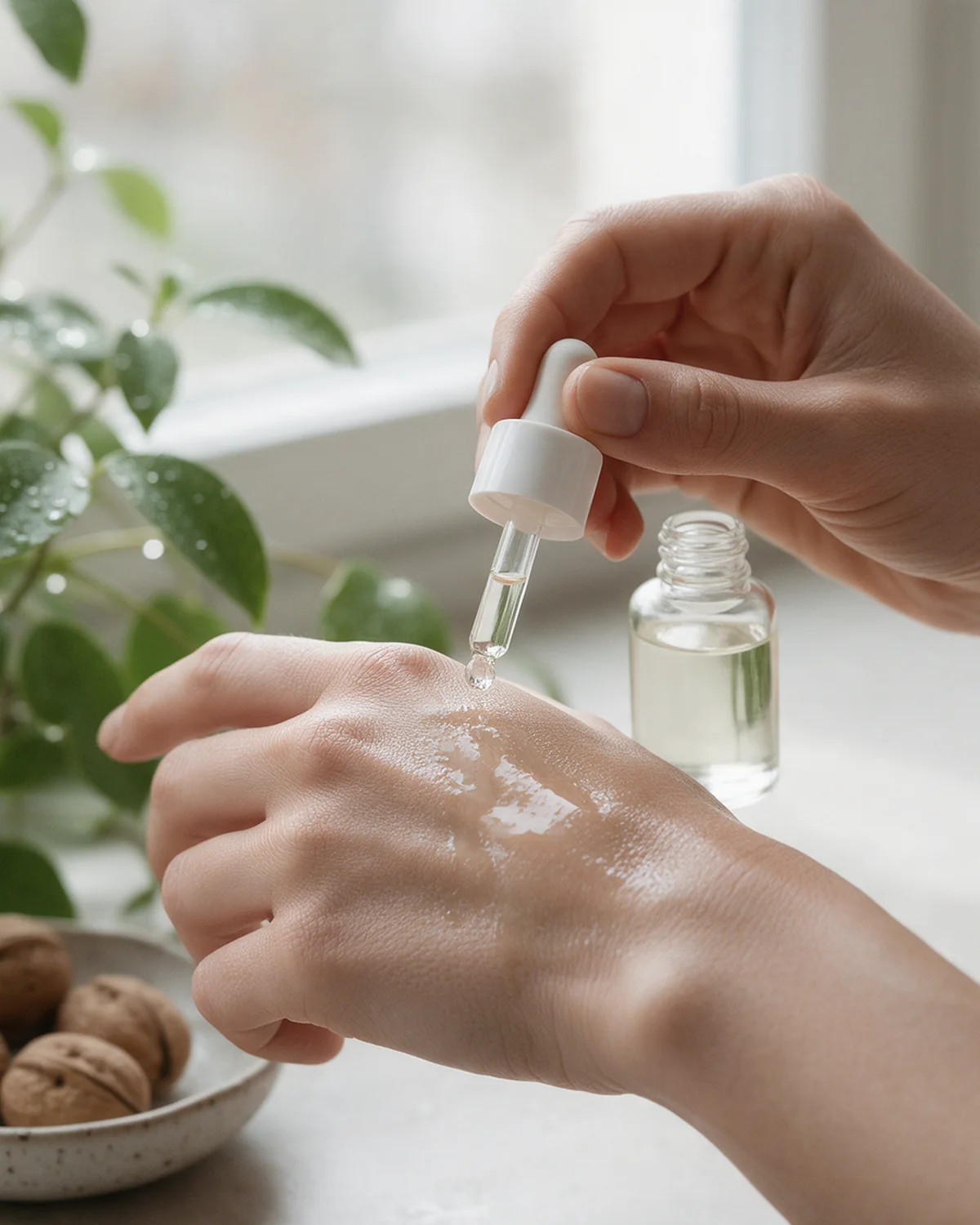
Most of what is sold as skincare has no trial behind it, and the three things that do have trials are the least glamorous: sunscreen every morning, enough sleep, and a short routine kept every day rather than a long one kept on Sundays.
This page is the routine in the order the evidence ranks it, with the studies quoted, their limits stated, and a clear line between cosmetic care, which this is, and care for a skin condition, which it is not.
The order of importance
- Sun protection. In a clinical grading of 298 women aged 30 to 78, ultraviolet exposure accounted for about 80 percent of the visible signs of facial ageing. In the Nambour randomised trial, 903 adults under 55 who used sunscreen daily showed 24 percent less skin ageing after four and a half years than those who used it when they felt like it. No serum has a result like that.
- Sleep. In a study of 60 women, poor sleepers scored higher on intrinsic skin ageing and their skin barrier recovered more slowly after being stripped; the study was small and the poor sleepers also differed in other ways, so it is a signal rather than proof. It is also free.
- A routine you keep. Cleanse, moisturise, protect. The evidence for most added steps is thin; the evidence that consistency matters more than product count is the whole of dermatology practice.
- Food. Covered on the skin nutrition page: the nutrients with a recognised role in normal skin, from a varied plant-based plate, without miracle claims.
- Not smoking, and alcohol in moderation. Both are consistently associated with earlier visible ageing in the observational studies; this is the one list where the advice is the same on every site.
The routine at a glance
| When | Step | Time | What the evidence says |
|---|---|---|---|
| Morning | Rinse or gentle cleanse | 15 seconds | Stripping cleansers damage the barrier the moisturiser repairs |
| Morning | Moisturise | 15 seconds | Humectants plus barrier lipids; price does not predict results |
| Morning | Sunscreen SPF 30 or more | 30 seconds | 24 percent less skin ageing over 4.5 years in the 903-adult Nambour trial |
| Evening | Cleanse once | 20 seconds | Removes sunscreen and the day |
| Evening | Moisturise | 20 seconds | The barrier loses more water at night |
| Evening, optional | One active, two nights a week | 10 seconds | Retinoids have the most trial evidence of any cosmetic ingredient |
| Night | Seven hours of sleep | 7 hours | Poor sleepers scored higher on skin ageing in a 60-woman study |
Morning: sixty seconds
Cleanse, or just rinse. Skin that was cleaned the night before does not need detergent in the morning; lukewarm water and a soft towel are enough for most, a gentle cleanser for oily skin. Hot water and foaming cleansers that leave the skin tight are stripping the barrier that the moisturiser then has to repair.
Moisturise. A plain moisturiser with humectants (glycerin, hyaluronic acid) and barrier lipids (ceramides, squalane, plant oils). Fragrance-free is the safer default for anyone with reactive skin, and price has no relationship to effectiveness in the comparisons that have been done.
Sunscreen, broad spectrum, SPF 30 or more. About a quarter of a teaspoon for the face and neck, every day the sun is up, including grey days and December in the north; UVA passes through cloud and glass and does most of the ageing. A tinted mineral sunscreen can replace foundation. This is the step that moves the ten-year picture, and the one most people skip.
Evening: forty seconds
Cleanse. Once, gently, to remove the sunscreen and the day. Double cleansing is for heavy makeup, not for everyone.
Moisturise. The same product or a richer one; the skin barrier does its repair work overnight and loses more water at night, which is why a night cream is a moisturiser with a different label.
Optional, one active, introduced slowly. If one more step is wanted, retinoids have the most evidence for fine lines and texture of any cosmetic ingredient, starting two nights a week with a low strength and always with morning sunscreen. Vitamin C serums have reasonable evidence as topical antioxidants, and niacinamide for barrier support and redness. One at a time, a month each, and nothing that stings for more than a minute.
Sleep as skincare
The 60-woman study is small, but it measured things that matter: the poor sleepers had higher scores for fine lines, uneven pigmentation and reduced elasticity, and their skin barrier took longer to recover after tape stripping, with more water lost through it. The contrary finding is that poor sleepers also had higher body weight, and a single study of 60 cannot separate the two. The larger literature on sleep and everything else makes seven hours a reasonable target for reasons that have nothing to do with the face. The practical version: a fixed wake time, a dark cool room, no screens for the last half hour, and caffeine before two in the afternoon.
What to look for, and what to ignore
- Look for: broad spectrum on the sunscreen, fragrance-free if reactive, a short ingredient list on the moisturiser, a retinoid at a strength that does not peel.
- Ignore: “dermatologist tested” without a published trial, before-and-after photographs in different lighting, collagen in a cream (the molecule is too large to enter the skin), detox, pore shrinking, and anything that promises to turn back ageing.
- Patch test any new product behind the ear for three days before it goes on the face.
- A product is working if the skin is comfortable, not tight, not shiny by noon, and the sunscreen goes on without rolling. That is the whole measure of a cosmetic routine.
When it is not a routine problem
Cosmetic care supports healthy skin; it is not care for a skin condition, and no change of cleanser or diet should stand in for seeing someone about one. Persistent acne, eczema, rosacea, psoriasis, new or changing moles, patches that bleed or will not heal, and sudden pigmentation changes belong with a dermatologist or a general practitioner, who has prescription options with trials behind them. Going there early is not vanity; it is the fastest route to skin that is comfortable, and a routine like the one above works alongside that treatment, never instead of it.
What the research says
- Flament and colleagues, Clinical, Cosmetic and Investigational Dermatology, 2013, clinical grading of 298 Caucasian women aged 30 to 78 by sun-exposure habits: ultraviolet exposure accounted for about 80 percent of the visible signs of facial ageing. The contrary finding: one population, observational, graded by assessors who could see the skin. doi.org/10.2147/CCID.S44686
- Hughes and colleagues, Annals of Internal Medicine, 2013, randomised trial of 903 adults under 55 in Nambour, Australia, daily sunscreen against discretionary use over 4.5 years: daily use produced 24 percent less skin ageing measured by silicone casts of the hand. The contrary finding: a subtropical population with high sun exposure, hand skin rather than face, and a modest absolute difference. doi.org/10.7326/0003-4819-158-11-201306040-00002
- Oyetakin-White and colleagues, Clinical and Experimental Dermatology, 2015, observational study of 60 women aged 30 to 49 classed as good or poor sleepers by questionnaire, single assessment: poor sleepers had higher intrinsic skin ageing scores and slower recovery of the skin barrier after tape stripping. The contrary finding: sixty women, one time point, and the poor sleepers also had higher body weight, which the study could not separate from the sleep itself. doi.org/10.1111/ced.12455
- Cosgrove and colleagues, The American Journal of Clinical Nutrition, 2007, cross-sectional analysis of 4,025 US women aged 40 to 74: higher vitamin C and linoleic acid intakes were associated with a less wrinkled and less dry appearance, with modest odds ratios. The contrary finding: self-reported diet at a single time point. doi.org/10.1093/ajcn/86.4.1225
Questions people ask
Do I need sunscreen in the Nordics in winter? For ageing, yes, on the days you are outside in daylight; UVA is present all year and passes through cloud. The vitamin D question is separate: in the north there is no skin synthesis from October to March whatever you do, so a winter supplement is the answer to that, not skipping the sunscreen.
Is a ten-step routine better? There is no trial showing it, and more products mean more chances of irritation. The best routine is the shortest one that is done every day.
Does food replace any of this? No. Food supplies what skin is built from; sunscreen stops it being broken down faster than it is built. They are different jobs.
My skin is oily, should I skip moisturiser? No. Stripped oily skin produces more oil. A light gel moisturiser and a gentle cleanser usually settle it within a few weeks.